
Facebook Ads Detroit: How Small Businesses Reach Metro Detroit Customers in 2026

Facebook ads Detroit businesses run often fail for the same reason: they are aimed at the whole metro area with one small budget, send people to a homepage and have nobody ready to answer the leads. Then the owner decides the platform does not work.
This guide covers the setup we recommend for small businesses in Metro Detroit: how to choose a radius or ZIP codes, how to split Wayne, Oakland and Macomb counties into service areas, what goes into a local offer, which campaign goal to pick and how to read the results. Facebook and Instagram ads are both managed in Meta Ads Manager, so everything here applies to both.
Still deciding how much to spend? Start with our guide to setting a minimum viable ad budget for a local business, then come back to build the campaign. And if you want the free foundation first, our Google Business Profile guide for Detroit shows how to get found when people search for you.
Why Facebook Ads Work for Detroit Small Businesses (and When They Do Not)
Facebook ads put your offer in front of people before they search. That makes them a strong fit when customers decide after they see you: a haircut, a detail, a tax appointment, a restaurant, a fitness class or a home project estimate. Compare that with an emergency plumber, where the customer is already typing a search with a credit card in hand. For those searches, Google Ads or a strong Google profile usually wins first. Our guide to what people search for most in Google Ads covers that side.
A simple rule: use Facebook ads to create demand and Google to capture it. Many Detroit businesses need both, but if you can only fund one, match the channel to how your customers buy.
How to Set Up Facebook Ads Detroit Targeting That Does Not Waste Budget
Do not target the city of Detroit alone
Detroit is the center of the region, but customers for many businesses live in the surrounding suburbs. Target only the city and you leave out places like Warren, Dearborn, Southfield, Troy and Livonia. Target the whole metro and you pay to reach people who will never drive to you. The fix is to start from your real service area and work outward.
Pick a radius or ZIP codes
You can drop a pin and set a radius around your location, or target specific cities and ZIP codes. Agencies commonly suggest tighter radii for restaurants and retail, roughly 3 to 15 miles, and wider ones for home services, often 15 to 30 miles. Treat those as starting points. Pull your last 50 customers and map where they live. If one ZIP code produces many of your best customers, give it its own ad set.
Understand the location setting
Meta's location setting is now "Living in or recently in this location." It no longer lets you separate residents from visitors, so write your copy for locals and name the neighborhood when you can. Location targeting is also not exact. Ads can reach people slightly outside your radius, so check where your leads actually come from instead of trusting the setting alone.
Keep the rest of your targeting broad
With a tight geographic area, your audience is already small. Piling on detailed interests shrinks it further and raises your cost. Let the location do the narrowing, use an age range that matches your customers and let Meta's delivery system find the people most likely to respond. Check the estimated audience size before you launch. If you sell to businesses instead of consumers, our guide to targeting job titles and employers on Facebook ads covers that case.
Build One Ad Set Per Service Area
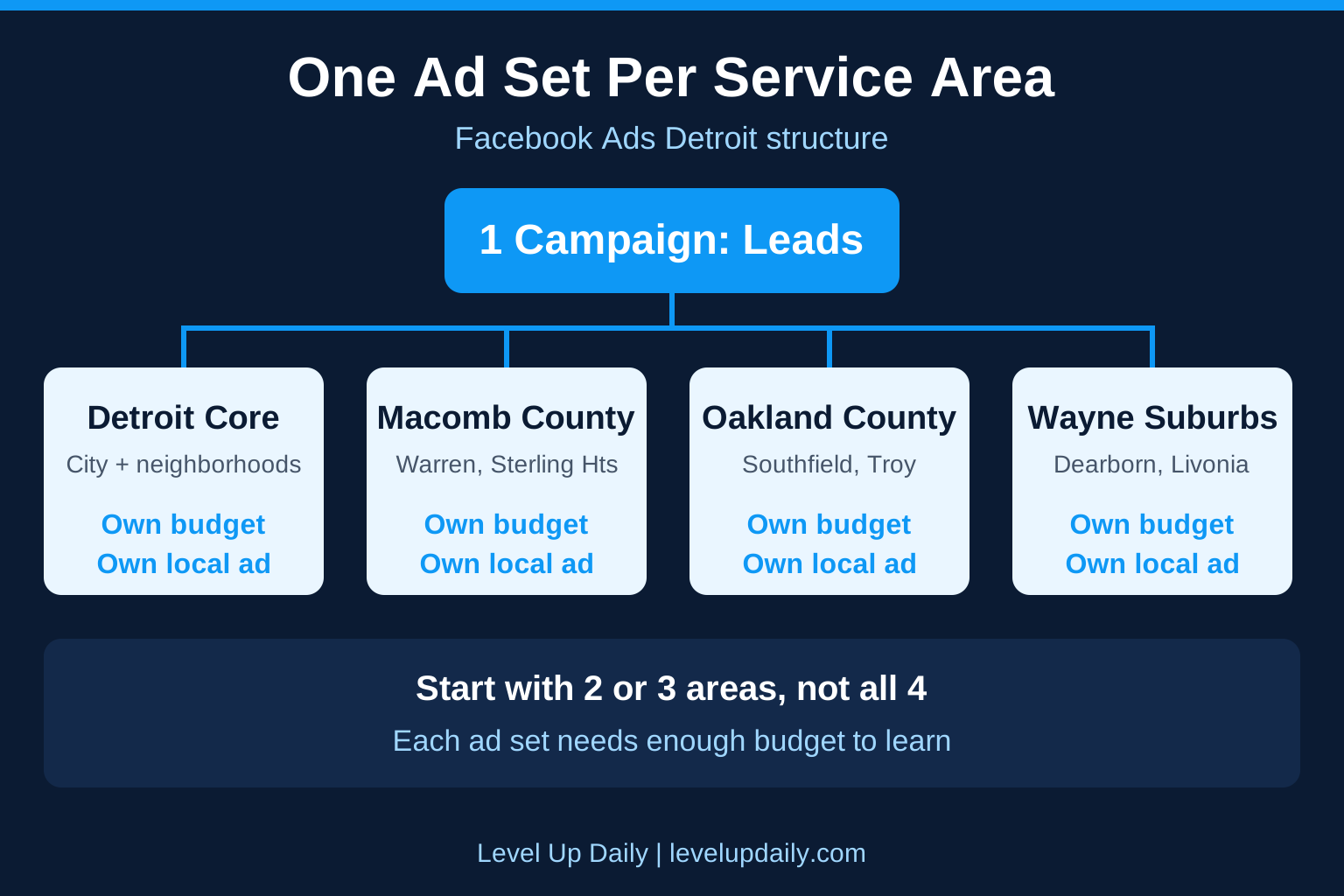
The most common structure mistake is one campaign, one ad set and one budget for the entire region. Meta then spends where leads are cheapest, which is rarely where your best customers are. Split your area instead. A typical Metro Detroit setup looks like this:
Detroit core: the city itself, with copy that names the neighborhoods or landmarks your customers recognize.
Macomb County: Warren, Sterling Heights, Clinton Township and nearby, with a message built around convenience and drive time.
Oakland County: Southfield, Troy, Royal Oak, Novi and nearby, where you may need a different offer or price point.
Wayne and Washtenaw suburbs: Dearborn, Livonia, Canton and Ann Arbor, if they sit inside your real service area.
Start with two or three of these, not all four. Each ad set needs enough budget to produce data. Meta's learning phase is commonly cited as needing about 50 optimization events a week, and a small budget split four ways will not get there. Fewer ad sets with a real budget beat many ad sets with a few dollars each. Agencies often cite roughly $10 to $20 a day per ad set as a floor for lead campaigns, but the right number depends on what a lead is worth to you.
Write Local Ad Copy and Offers That Detroit Customers Respond To
Local ads win on specifics. Name the area, name the offer and make the next step obvious. Generic copy like "We offer quality service" gives the scroller nothing to react to.
Name the place: put the city or neighborhood in the headline or first line, such as Southfield, Dearborn or the Eastside. It tells the right person the ad is for them.
Lead with one clear offer: a first visit price, a free estimate or a limited number of openings this week. Pick one and make it easy to grasp in a few seconds.
Show the real thing: use real photos and video of your work, your space and your team, not stock images.
Add proof: a real review, a before and after, or a number you can back up, such as years in business.
Ask for one action: book, call or get a quote. Do not ask for three things.
Here is a simple template you can adapt:
[Service] in [City]? [Specific offer]. [One line of proof from a real customer or result]. [Book, call or get a quote] today.
Our breakdown of which Facebook ads work best covers video, carousel and testimonial formats you can test inside this structure.
Pick the Right Campaign Goal: Leads, Calls, Messages or Traffic
The goal you choose tells Meta what to optimize for, so pick the action that actually makes you money.
Leads: best for estimates, consultations and appointment based services. Instant forms let people submit their details without leaving Facebook, which keeps friction low. The tradeoff is that some leads are less serious, so add one qualifying question to the form.
Calls: best for home services and urgent needs, where a phone call is the sale.
Messages: works when your customers prefer to text or message with questions. It only works if someone answers quickly.
Website traffic or conversions: best when you have a landing page built for one offer. Send people to a focused page, not your homepage.
Whatever you choose, answer fast. A person who filled out a form while scrolling is not waiting around. Set a rule for your team, such as replying within minutes during business hours, and use an automatic confirmation message so the person knows the request arrived.
Add Retargeting and Follow-Up
Most people will not act the first time they see you. Retargeting shows your ad again to people who watched your video, visited your site or engaged with your page. For a local business this is often the cheapest audience you can reach, because they already know you. Our retargeting guide covers how to segment these audiences.
Follow-up matters as much as the ad. Keep a simple sequence: reply fast, send a reminder before the appointment, then ask for a Google review after the job. That review feeds the profile we covered in our Google Business Profile guide, which helps you show up when people search for you later.
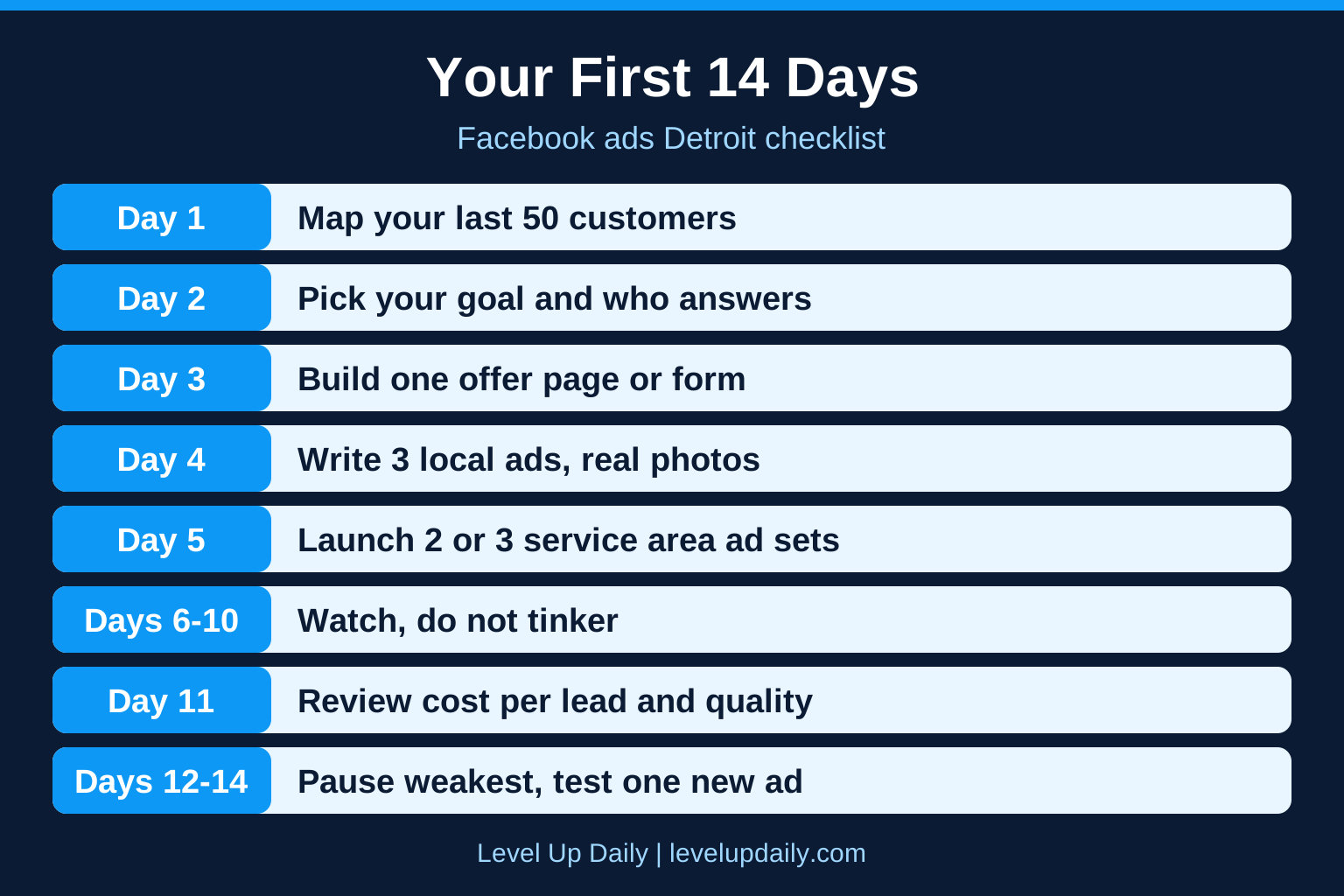
Facebook Ads Detroit Checklist: Your First 14 Days
Day 1: pull your last 50 customers and map where they live by city or ZIP code.
Day 2: choose your goal (leads, calls or messages) and decide who answers each one.
Day 3: build a focused landing page or instant form for one offer.
Day 4: write three ads that name the area, state one offer and use real photos or video.
Day 5: launch two or three ad sets by service area, each with a budget it can actually use.
Days 6 to 10: watch, do not tinker. Big edits can send an ad set back into the learning phase.
Day 11: review cost per lead and lead quality by ad set.
Days 12 to 14: pause the weakest ad, keep the best one and add one new variation to test.
How to Tell Whether Your Facebook Ads Are Working
Clicks and likes are not results. Track three numbers instead:
Cost per lead by ad set: shows which service area deserves more budget.
Lead to booking rate: shows whether the leads are real and whether your follow-up works.
Cost per booked customer: the number that decides whether to scale.
A campaign with a higher cost per lead can still be the better one if those leads book more often. Give each campaign at least two weeks of data before you judge it, and compare the result with what it costs you to win a customer elsewhere. For a reference point on agency and ad spend in the region, see what a digital marketing agency costs in Detroit, and for a deeper look at tuning campaigns, read our guide to optimizing Google and Facebook ads for ROI.
Common Facebook Ads Mistakes Detroit Businesses Make
Boosting posts instead of building campaigns: the boost button skips goal and location choices that matter.
Targeting the whole metro with one budget: Meta spends where leads are cheapest, not where your best customers live.
Sending traffic to the homepage: give people one page and one action.
Slow follow-up: the best ad cannot fix a lead that waits a day for a reply.
Changing things every day: constant edits make it impossible to learn what works.
Ignoring special ad rules: if you advertise housing, employment or credit offers, Meta limits targeting in those categories, so check its current policy before you build.
Frequently Asked Questions:
How much should a Detroit small business spend on Facebook ads? It depends on what a customer is worth to you. Many agencies treat roughly $10 to $20 a day per ad set as a working minimum for lead campaigns, but start by working backward from your cost per booked customer so you know what a lead is worth.
Should I target Detroit or the whole Metro Detroit area? Start from your real service area. Targeting only the city misses suburbs where many customers live, and targeting the whole region wastes budget on people who are too far away. Build separate ad sets by service area and compare the results.
How long until Facebook ads start working? Plan on at least two weeks of data before judging a campaign. Meta's system needs time to learn, and small budgets take longer to give a clear picture. A strong offer and fast follow-up shorten that time.
Are Facebook ads better than Google ads for a local business? They do different jobs. Facebook ads create demand by reaching people before they search, while Google captures people who are already searching. Match the channel to how your customers buy, and use both if your budget allows.
Do I need a website to run Facebook ads? Not always. Instant forms, calls and messages can work without one. A focused landing page for each offer usually converts better, and it gives you somewhere to send retargeting traffic.
Can I target people by income or neighborhood? You can target by location, including cities and ZIP codes. Meta has reduced detailed targeting options over time, and special ad categories such as housing, employment and credit have extra limits, so check Meta's current rules for your industry.
Not sure how to structure your first campaign? Book a free strategy call and we will map out your service areas, offer and budget with you.
Ready to Turn Facebook Ads Into Booked Customers in Detroit?
If you would rather have a plan built around your actual customers and service area than guess, let's talk it through.


Comments