
Restaurant Marketing Detroit: The 2026 Playbook for Metro Detroit Restaurants and Bars

Good restaurant marketing Detroit owners can count on starts at the moment a hungry guest pulls out a phone. They search a few words, scan the first few results and pick the place that looks right. If your restaurant or bar is not in that short list, the food you work so hard on never gets the chance to speak for itself.
This guide walks through a complete restaurant marketing Detroit playbook for Metro Detroit restaurants and bars, from your Google listing to reviews, social media, email and a small ad budget. It works for a Corktown bar, a Dearborn family restaurant or a Royal Oak lunch spot, because the fundamentals are the same. You do not need a huge budget. You need the basics done well and done every week.
Want the map side first? Start with our Google Business Profile guide for Detroit, then come back here for the full restaurant plan.
What Makes Restaurant Marketing Detroit Specific
Metro Detroit is not one dining market. A guest searching in Midtown behaves differently from a family in Troy or a group heading to a game downtown. Competition runs from national chains with big budgets to independents on every corner, and winter slows weekday traffic in a way that patio season hides. Your marketing has to reflect that mix.
Three things shape how guests choose where to eat in Metro Detroit:
Proximity. Most searches are "near me" or a neighborhood name like Ferndale, Corktown or Birmingham. If Google does not clearly understand where you are and what you serve, you will not show up.
Proof. Fresh photos, recent reviews and active social profiles tell a guest you are open, busy and worth the trip.
Convenience. If a guest cannot see your menu, hours and a way to book or order in one or two taps, they move on to the next option.
The Restaurant Marketing Stack: Five Channels That Fill Tables
Think of your marketing as a stack. Each layer supports the next, and skipping the bottom layers makes everything above them work harder. Here is the order we recommend for Detroit restaurants and bars.
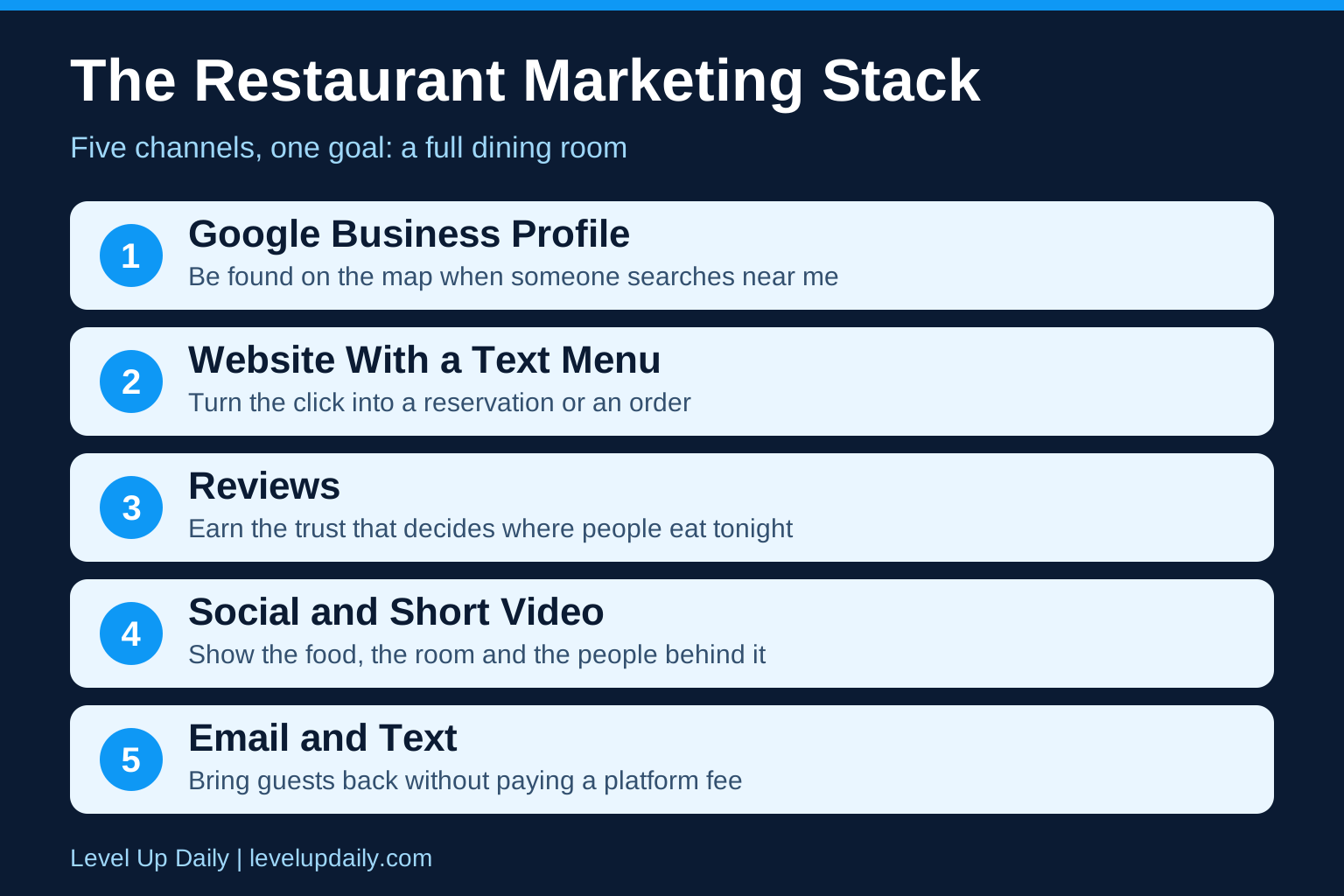
Step 1: Build a Google Business Profile That Brings in Hungry Searches
For most restaurants, your Google Business Profile is the front door. It is the map pin, the star rating, the photos and the call button a guest sees before they ever visit your website. Treat it like a storefront you update weekly.
Choose the most specific primary category that fits, such as Coney island restaurant, Italian restaurant or sports bar, and add secondary categories only when they are true.
Keep hours exact, including holiday hours, kitchen close times and happy hour windows.
Add your menu link, an order link and a reservation link so guests can act without leaving the listing.
Upload new photos regularly: the food, the bar, the dining room, the exterior and the entrance, so first time guests can find the door.
Post a weekly update about a special, an event or a seasonal item, and answer questions guests ask on the profile.
Respond to every review, good or bad.
We cover claiming, verifying and ranking in detail in our Google Business Profile Detroit guide, and the wider checklist in our local SEO checklist for Michigan businesses.
Step 2: Make Your Website a Menu and a Reservation Machine
Your website has one job for a restaurant: turn a curious searcher into a guest. That means fast pages on a phone, a menu people can read and an obvious next step.
Put the menu in real text
A menu saved as a PDF or a photo is hard to read on a phone and hard for Google to understand. Publish it as real page text with prices, and Google can match your dishes to what people search for. Add your neighborhood and city naturally, such as "burgers in Royal Oak" or "late night menu in Detroit."
Make the next step obvious
Put a tap to call button, a directions link and a Reserve or Order button at the top of the homepage. Do not make guests scroll to find your hours.
Push regulars toward direct ordering
Delivery apps are useful for discovery, but they take a cut of every order. Give your regulars a reason to order direct with a simple online ordering page linked from your profile and your social bios. If your site is not bringing in visits, read why your website is not getting traffic and how to fix it.
Step 3: Turn Happy Guests Into Reviews
Reviews decide close calls. When two restaurants look similar on the map, the one with more recent, more detailed reviews usually wins the tap. A steady flow matters more than a one time push.
Ask at the right moment: right after a great meal or a compliment to the server, not at the door on the way out.
Put a QR code that opens your review page on the check presenter, the receipt, the table tent or the bar menu.
Give your team a simple line to use, such as "If you enjoyed it, a quick Google review helps us a lot."
Never offer a discount or a free item in exchange for a review. Google's policies prohibit it, and it can put your listing at risk.
Respond to every review within a day or two. A thoughtful reply to a negative review shows future guests how you handle problems. Here is a simple template you can adapt:
Thank you for the feedback, and we are sorry the visit missed the mark. We would like to make it right. Please email us at [your business email]e or call the restaurant so we can talk it through.
Swap in your own contact details and keep the reply short, specific and free of excuses.
Step 4: Use Social and Short Video to Show the Room, Not Just the Plate
Restaurants sell an experience, so show it. Guests want to see the pour, the sizzle, the crowd and the people behind the counter. Short video on Instagram and Facebook is the easiest way to do that without a production budget.
A 15 second clip of a signature dish being plated or a cocktail being built.
A quick behind the scenes moment with the chef, the bartender or the prep team.
Tonight's special posted by mid afternoon, with the location tagged.
Events like trivia, live music and watch parties, posted as Facebook events so people can respond and share.
Guest photos and tagged posts, reshared with permission.
Consistency beats perfection. Three solid posts a week is better than a burst of content followed by silence. For ideas on selling without sounding salesy, see our post on selling on TikTok and Instagram.
Step 5: Build an Email and Text List You Own
Social platforms change their rules and reach all the time. An email and text list gives you a direct line to guests who already like you, and it does not depend on an algorithm.
Collect emails through your reservation form, online ordering page, guest Wi-Fi sign in or a QR code on the receipt.
Get clear permission before you send marketing texts, and make it easy to opt out.
Send on a steady schedule, such as every other week, with one offer and one upcoming event.
Segment when you can, for example a note for brunch regulars and a different one for late night crowds.
If you want to speed up writing and testing your emails, our post on using AI to improve your email marketing shows how to do it without losing your voice.
Paid Ads for Restaurants: Where a Small Budget Works
Ads should support a plan that already works, not replace it. Once your profile, site and reviews are in good shape, a small budget can fill slow nights and promote events.
Target a tight radius around your location instead of the whole region.
Promote one specific offer for one slow night, such as a Tuesday special, rather than a general brand ad.
Retarget people who visited your menu or reservation page but did not book.
Send every ad to a page with a clear Reserve or Order button, and track the results.
Start small and scale only what works. Our guides on setting a minimum viable ad budget and Facebook ads for Metro Detroit small businesses walk through the numbers and the setup.
How to Tell Whether Your Restaurant Marketing Is Working
You do not need a complicated dashboard. Check these numbers once a month and write them down so you can see the trend.
Calls, direction requests and website clicks from your Google Business Profile.
Reservations and online orders, and where they came from.
Email and text list growth.
Review count, average rating and how many reviews you earned this month.
The answer to one simple question at the host stand or bar: "How did you hear about us?"
A 30 Day Restaurant Marketing Detroit Checklist
If you want a starting point, follow this schedule. It is built for an owner or manager with limited time.
Week 1: Fix the foundation. Audit your Google Business Profile, correct hours and categories, add menu and order links, and upload fresh photos.
Week 2: Upgrade the website. Publish the menu as text, add call, directions and Reserve buttons, and test the site on your own phone.
Week 3: Launch the review system. Create the QR code, brief the team on the ask and reply to every open review.
Week 4: Start the content and email rhythm. Post three times, send your first email and set one small ad for your slowest night.
Every week after: Update the profile with a post, share one event or special and review your numbers once a month.
Common Restaurant Marketing Mistakes in Detroit
Using a PDF or photo menu that guests cannot read on a phone.
Leaving old hours or a closed location on the Google listing.
Ignoring reviews, especially the negative ones.
Discounting everything instead of promoting one clear offer.
Posting only when business is slow, then going quiet when it is busy.
Boosting posts with no goal, no tracking and no clear next step.
Frequently Asked Questions:
How much should a Detroit restaurant spend on marketing? There is no single number. Many independent owners budget a small percentage of sales, and the right amount depends on your margins, seasonality and growth goals. Start with the free basics in this guide, like your Google profile and reviews, before you pay for ads.
What is the fastest way to get more customers? Fix your Google Business Profile first. Accurate categories, current hours, fresh photos and recent reviews can improve how often guests find and choose you, and the work costs nothing but time.
Do I need a website if I already have social media? Yes. Social media is rented space, while your website is yours. A fast site with a text menu, hours, directions and a Reserve or Order button gives guests a clear next step and helps Google understand your business.
How many reviews does my restaurant need? There is no magic number. Rating, total count and how recently you earn new reviews all matter, so aim for a steady flow every week instead of a one time push.
Is Instagram or Facebook better for restaurants? It depends on your guests. Instagram is strong for food and drink visuals, while Facebook works well for events, local groups and older audiences. Test both for a month and keep the one that brings in more calls, bookings and visits.
How long does restaurant marketing take to work? Profile and website fixes can show movement within weeks. Reviews, content and email build over months, and results vary by competition and location, so judge progress by steady trends instead of one busy weekend.
Want a second set of eyes on your restaurant's marketing? Book a free strategy call and we'll help you find the gaps.
Ready to Fill More Tables?
If you would rather talk through your actual goals than guess, let's have that conversation.


Comments